Wrap-Up & Resources#
(Lecture time: 1:20–1:30, incl. Q&A)
The whole lecture on one slide#
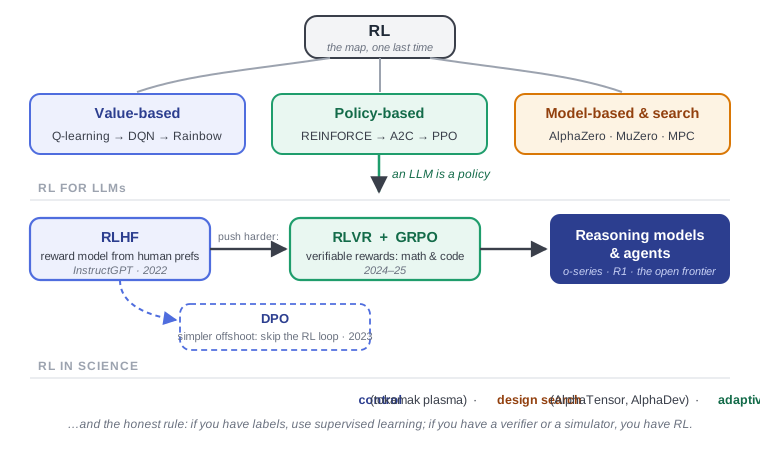
- RL = learning from evaluation, not instruction.
- The Bellman equation is the recursive backbone; everything else approximates it.
- Deep RL = replace tables with networks; DQN stabilizes value learning, PPO stabilizes policy learning.
- LLMs are policies. RLHF aligned them; RLVR (verifiable rewards + GRPO-style training) produced reasoning models; agents are the open frontier.
- In science, RL shines for control, design search, and adaptive experimentation — and is the wrong tool when you have labels, no simulator, or no clean reward.
Where to go next#
Books & courses
- Sutton & Barto, Reinforcement Learning: An Introduction (2nd ed.) — free online, still the canonical text.
- OpenAI Spinning Up in Deep RL — the best bridge from theory to code.
- Hugging Face Deep RL Course — hands-on, free, modern tooling.
- David Silver’s UCL lectures — classic video series for the foundations.
Code
- CleanRL — single-file, readable implementations of the classic algorithms.
- Gymnasium — standard environments (CartPole, LunarLander, Atari, MuJoCo).
- TRL (Hugging Face) and verl — RLHF/GRPO training for LLMs.
- Stable-Baselines3 — batteries-included classic deep RL.
Papers to start with (one per lecture section)
- Mnih et al., Human-level control through deep RL (DQN, Nature 2015)
- Schulman et al., Proximal Policy Optimization (2017)
- Ouyang et al., Training LMs to follow instructions with human feedback (InstructGPT, 2022)
- DeepSeek-AI, DeepSeek-R1: Incentivizing reasoning capability in LLMs via RL (2025)
- Degrave et al., Magnetic control of tokamak plasmas through deep RL (Nature 2022)
Contact#
Elynn Chen · elynn.chen@stern.nyu.edu · elynncc.github.io.
Slides and the demo notebook are linked from the landing page.